Virtue, Vice, and Revision

The dance of life. Photo by emdot, Creative Commons License

Week 52: A Temporary Farewell

A thankful heart is not only the greatest virtue, but the parent of all other virtues. —Cicero

In my impetuous youth, I took the drug ecstasy three times. All three were with the same friend, and the first time gave us everything we had hoped for and more. I would not describe the experience as ecstatic—a state I associate with at least a tinge of frenzy—so much as being joyfully at peace and entirely engaged. I knew that the drug had been used in psychotherapy before it had been outlawed in 1985 (shortly before I tried it), and I immediately grasped its therapeutic promise. To experience such a state of transcendent openness, even when artificially induced, was to touch the possible.

Our subsequent trials were not as successful. We weren’t really druggies; we didn’t have dependable “connections.” One of the problems with illicit drugs is that there is no quality control, and who knows what comprised our later purchases. They produced no pleasurable effects but left us feeling headachy and buzzed, like we’d taken No Doz or drunk too much coffee, and no doubt the tablets contained some combination of caffeine and other fillers like ibuprofen or talcum powder. At any rate, the third dose concluded my attempt at psychotropic experimentation, and I believe I would have abandoned it even if it had been more fun. Achieving enlightenment with the help of chemicals seemed like cheating.

In truth, I have enjoyed moments of peak experience without artificial assistance — once, surfing off the frigid coast of the Tasman Sea during a year as an exchange student in New Zealand; another time climbing Mount Hinman in Washington; several times on the ranch in Wyoming when I felt at one with my horse and the terrain, and more recently in prayer and meditation. Many religious traditions use mind-altering plants or extreme exertion as visionary sacraments, and though I claim no knowledge of the subtleties of such rituals, I sense that the idea is to experience the sublime in order to bring it more readily into quotidian awareness. Once we experience the presence of God or oneness or however we might describe the transcendent, we will arrange our lives to stand as near it as we can.

I have been thinking about such things as I conclude this year-long meditation I have called the Year of Living Virtuously (Weekends Off). As I mentioned in the first post, I embarked on this journey not to seek moral perfection but rather to live consciously. “You do not have to be good,” wrote the poet Mary Oliver in her extraordinary poem “Wild Geese.” “You do not have to walk on your knees/For a hundred miles through the desert, repenting.” Rather, Oliver suggests,

Whoever you are, no matter how lonely,
the world offers itself to your imagination,
calls to you like the wild geese, harsh and exciting –
over and over announcing your place
in the family of things.

Our sacred task, in other words, is to listen for our true calling in order to act, so far as we are able, on what we hear.

I embarked on this project as something of a lark. I wanted to start writing seriously again after concentrating for some years on visual art, and I created the blog to provide structure and form for practice. My interest in the virtues and vices was sincere, but I imagined the posts as short, humorous, and sometimes self-deprecating observations of one woman’s fantastic battle with herself (to paraphrase E. B. White). But I quickly found that my daily foibles didn’t interest me much (and certainly wouldn’t interest you) and turned instead to pondering how these basic moral themes play out on the larger stage.

The year turned into a profound experience of concentrated listening. Sincere practice has a way of drawing us into uncharted territory, and though many of the personalities and experiences I wrote about were familiar to me before I started, the desire to distill those voices for others made me ask more questions. So I have benefitted this year not only from the chance to “listen” to people and events that I see as generous forces in the world, but to enjoy as well the extraordinary privilege of being listened to. Your presence, dear readers, as well as your responses, have placed me in the center of a conversation that has stretched and enlightened me beyond my wildest imaginings.

In the beginning I said that I didn’t expect the year to change me. Certainly I wanted to protect myself from any expectation that I was or could become a paragon of virtue, and I can safely say that I am no more virtuous now than I have ever been. But the year has changed me—that’s the gift of mindfulness. After writing about the poet William Stafford’s habit of clearing his desk each day so he could meet a new poem fresh each morning, I somehow abandoned a lifetime habit of clutter to find myself tidying my work space each night before I go to bed. After my post about the new frugality, Hal and I decided to downsize, and are putting our big old house on the market this coming spring. Other bad habits still plague me. No matter how insightfully I have considered wrath and procrastination, I am still quick to temper and slow to get things done.

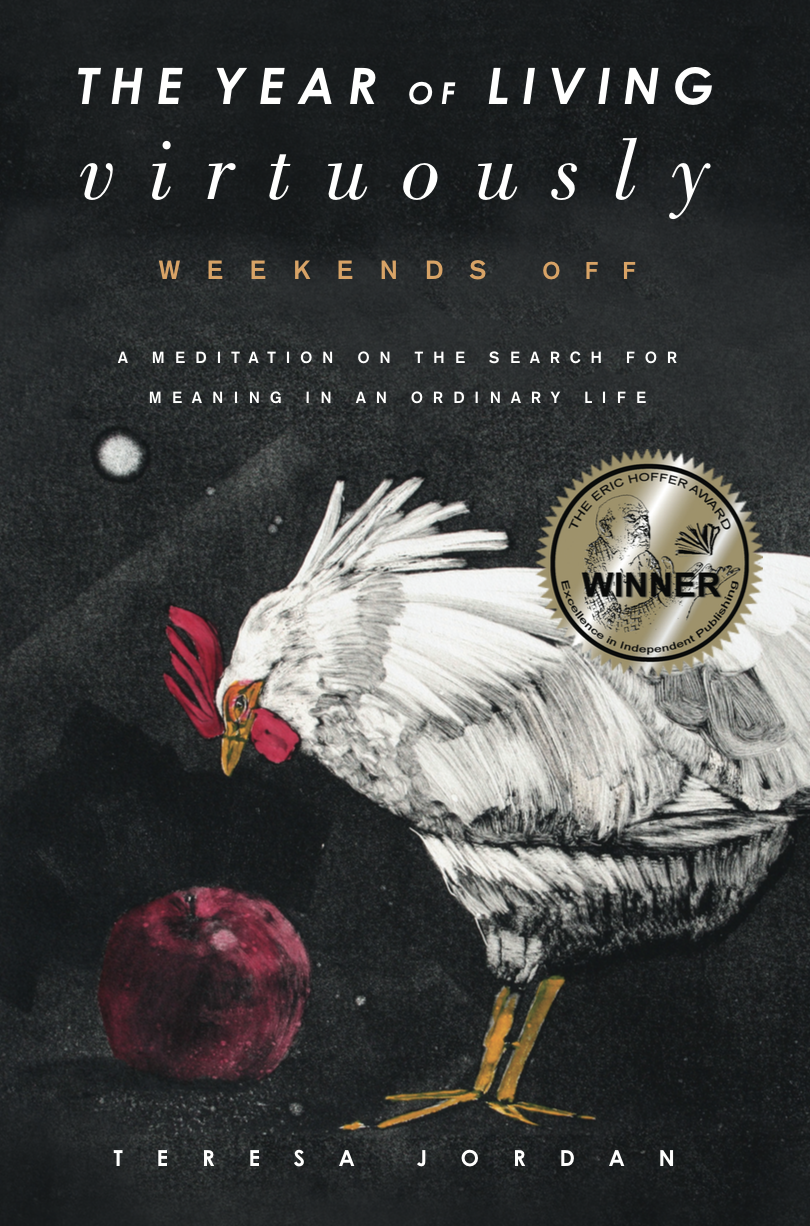
Many of you have kindly suggested that I continue this project beyond its initial year, a vote of confidence that touches me to my core. But it is time to step back from weekly deadlines and set upon the task of sculpting these musings into more durable form. Some posts seem weak to me now and need to be carved away; other topics, such as love and faith, deserve deeper consideration than I could give them within the time constraints. Still other topics, such as betrayal and selfishness, seemed too large to tackle at all in a single week, and need my attention now. The posts I have written so far will remain online until at least the end of 2011 and I hope I will have a deeper, richer book to offer you sometime next year.

As Hal suggested last week, the process of creating this blog has often been more agony than ecstasy. I remain, after a year of weekly practice, a slow and ponderous writer. One of life’s great paradoxes is that something so painful can be at the same moment pleasurable. Aristotle saw happiness not so much as a state of mind as an activity, and I suspect that what I have been seeking all along is not ecstasy so much as harmony, a way to place myself, as Mary Oliver might put it, “in the family of things.”

You, dear readers, have been part of that family and your embrace has given me gifts beyond reckoning. I believe Cicero is right that gratitude is the parent of all other virtues. The gratitude I feel for you makes me virtuous indeed.


Read full storyComments { 32 }

The Year of Being Married to the Year of Living Virtuously

Week 51: Sharing

Back when we both had dark hair...


I hold this to be the highest task for a bond between two people: that each protects the solitude of the other. —Rainer Maria Rilke

Of Consciousness, her awful Mate. The Soul cannot be rid — as easy the secreting her behind the Eyes of God. —Emily Dickinson

Hal Cannon Chimes In

I asked Teresa if I could contribute the next-to-to last offering in her fifty-two-week exploration of virtue. She reluctantly accepted but made me promise that I wouldn’t go too heavy on the praise.

That will be easy since this project has been a mixed blessing for the Cannon/Jordan household, akin to a year-long, self-directed Masters Program with an incredible reading list and a major paper due weekly. Like many who have been widowed by the demands of scholarship, I’ll be damn glad when the diploma arrives: Master of Virtuosity from the University of Webtronics in Blogaphiric Studies. (more…)

Read full storyComments { 17 }

The Good Hand

Week 50: Manners

The test of good manners is to be patient with bad ones. —Solomon ibn Gabirol, 11th century Jewish philosopher

“Manners should be a technique of inclusion, a way of ensuring that in our company no one will ever be made to feel he is an outcast. — Quentin Crisp, Manners from Heaven

When my brother and I were small, we had, like most ranch kids, reasonably good manners. We said please and thank you, asked to be excused from the table when we were through eating, and—once telephone service came to our isolated ranch community—identified ourselves whenever we made a call. Though it sometimes took some prodding from our mother, we were conscientious about thank-you notes. (Always loquacious, I tended to be flowery, but my brother cut to the chase. One Christmas, acknowledging the soap-on-a-rope he received from our cousins, he wrote simply: “Thanks for the soap. I needed it.”)

Being kids, we sometimes came up short, but one place we never forgot our manners was in the barn. To this day, I say “Whoa” to announce myself whenever I walk into a barn. A startled horse may strike out in fear; if I was rude or alarming or simply self-absorbed, I could get kicked in the head. It was an object lesson in the purpose of manners: to make another feel safe and at ease. (more…)

Read full storyComments { 13 }

On the High Wire

Week 49: Balance

This book has been with me on so many adventures that its pages are curled and stained.

If I see three oranges, I have to juggle. And if I see two towers, I have to walk. —Philippe Petit

What I dream of is an art of balance. —Henri Matisse

One of the earliest stories my family tells about me is from a time I was too young to remember. As soon as I learned to crawl, they say, I loved to climb. One day, one of the men on the ranch was repairing our roof and had set his extension ladder against the wall of our two-story house. He was working on the peak when he heard me gurgling behind him, voicing the toddler equivalent of “whatcha doin’ up here?” (more…)

Read full storyComments { 10 }

The Unidentified Flying Taxista

Week 48: Travel

Photo by Francis Mariani, Creative Commons License

There are no foreign lands. It is the traveler only who is foreign. – Robert Louis Stevenson

The traveler sees what he sees, the tourist sees what he has come to see. – G. K. Chesterton

The summer is flying by, and I, for one, have had too much moralizing and not enough amusement. I’m ready for the “Weekends Off” part of the equation. This week, a story from Argentina, where I spent several months a while back in a belated attempt to learn Spanish. (more…)

Read full storyComments { 4 }

What George Might Say to Us Today

Week 47: Governance

George Washington by Gilbert Stuart Williamstown, Wikimedia Commons

Congress Continues Debate Over Whether or Not Nation should be Economically Ruined. —Headline in the satirical paper The Onion, July 20, 2011.

One of the expedients of party to acquire influence within particular districts is to misrepresent the opinions and aims of other districts. You cannot shield yourselves too much against the jealousies and heartburnings which spring from these misrepresentations…. —George Washington, Farewell Address, 1796

I have very purposefully refrained in this blog from commenting on current events, most especially political ones. But as we slouch toward national default, which brings with it not only the specter of economic chaos but also of national disgrace, I am sick at heart. As I write, both parties are working toward an eleventh-hour deal that will raise the debt ceiling before we begin to renege on our obligations on August 2. And both parties are threatening to act independently if they don’t get their way. (more…)

Read full storyComments { 6 }

True Vine

Week 46: Love


I’ve long thought that love was not only a mystery, but also a talent. It is a gift to be able to receive love, to have the capacity to take it fully into the heart. And it is a gift to be loving, to offer love without caveat. My husband, Hal Cannon, learned a lot about love the day he visisted Ella Gant McBride, the last living member of a folksinging family that the legendary collector, John Lomax, first recorded in Austin, Texas, in the midst of the Great Depression. This week, a guest post. (more…)

Read full storyComments { 7 }